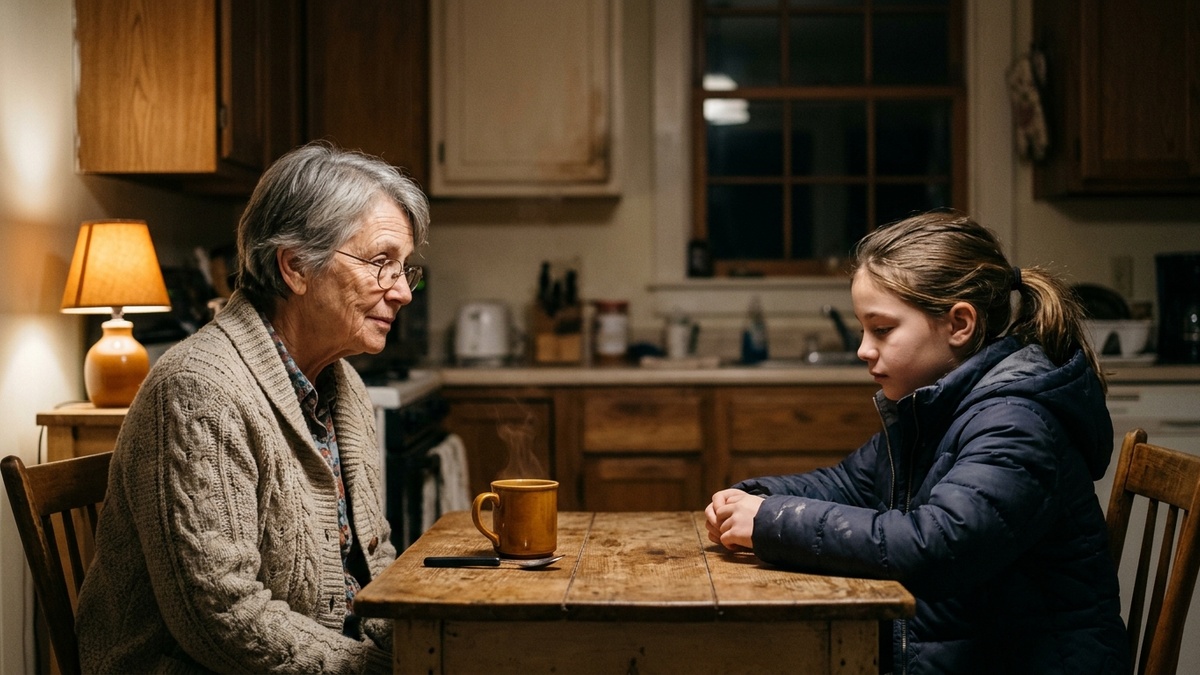
Loretta Fry had been a licensed emergency foster parent in Calder County for exactly nine days when the social worker called at eleven at night and said, "Three kids. Siblings. Their mother died on Route 9 this evening. Can you take all three?"
Loretta was already reaching for her slippers.
"How old?"
"Twelve, eight, and four."
"Bring them," Loretta said. "I'll put the kettle on."
She was sixty-nine. For thirty-one years, she had been a bailiff in the juvenile court in Cleveland. She had stood beside the bench in a gray uniform through more custody hearings than she could count, and she had watched what happened to children when the grown-ups in their lives fought over them like a pickup truck at an estate sale.
She had moved to Pine Hollow in September, to a little yellow house on Maple Street, two doors down from Hank and Lorraine Doyle. She had told the county she wanted to foster because she was retired and widowed and had too many empty bedrooms.
That was true. It was not the whole truth. The whole truth was that she had spent thirty-one years watching, and she was tired of only watching.
The Ritter children came in out of the snow at midnight, holding hands in a line.
Mia was twelve, thin and fierce, with her mother's car keys still in her coat pocket. Noah was eight and would not let go of a stuffed dog that had once been white. Hazel was four, asleep on the social worker's shoulder.
Their mother, Amanda Ritter, had been thirty-four. She had raised them alone on a small farm off Lutz Hollow Road, with a few goats, a big garden, and a job at the feed store. Her car had gone off Route 9 on black ice on the way home from her shift. The sheriff had been there in nine minutes. It had not been soon enough.
Loretta made cocoa. She put Hazel in the bottom bunk and Noah in the top. Mia would not go to bed. She sat at the kitchen table in her coat, staring at the wall.
"You don't have to talk," Loretta said, sitting down across from her.
"I know I don't." Mia's voice was flat. "I've been to foster care before. When I was six. When Mom was sick."
"Then you know how it goes."
"I know it's bad," Mia said.
Loretta did not argue with her. She just sat there, all night, until the girl finally put her head down on the table and slept.
The fight started three days after the funeral.
Amanda Ritter had left a will. It was a simple one, written with a lawyer in Marietta after the children's father left. It named her best friend, Jess Miller, as guardian if anything ever happened. Jess was thirty-three, an Army medic who had served in Afghanistan, and she rented a farm on Creek Road with her husband, Luke, and forty cows.
But the will had never been signed in front of two witnesses. Only one. In Ohio, the probate judge said, that was not enough to name a guardian automatically. The court would have to decide.
And Amanda's half brother, Dale Voss, had filed a petition to be guardian of all three children.
Loretta had never met Dale Voss. But she had heard the name at Dot's diner on her second day in town. Dale Voss was the man who had been banned from the Calder County sale barn for running up bids on his own cattle. Dot had said his name the way some people say "termite."
"He's never even met Hazel," Mia said, when Loretta told her. "He came to the house once, when Noah was a baby. He wanted to borrow money from Mom. She said no."
"Why would he want to be your guardian, then?"
Mia looked at her with old, tired eyes.
"There's insurance," she said. "From Mom's job. Mom told me once. She said it's for college. She said it's two hundred and fifty thousand dollars."
Loretta was quiet a moment.
"And the farm," Mia said. "The farm's ours too."
The hearing was set for a Thursday in the Calder County probate court, upstairs in the old courthouse.
Loretta had sat in a hundred courtrooms like it. Dark wood, a radiator that clanked, a flag in the corner, a clock that ran four minutes fast. She sat in the second row with Hazel on her lap and Noah beside her, holding his stuffed dog. Mia sat on her other side, very straight.
Jess Miller sat at one table with a young lawyer from legal aid. Dale Voss sat at the other with a lawyer from Zanesville in a dark suit.
Dale was fifty-two. He wore a new sport coat, a new tie, and a haircut that still showed the comb lines. He looked like a man who had been told how to look.
His lawyer was good. Loretta had to give him that.
He told the judge that Dale was the children's only blood relative. That he owned his own home and had steady work. That the Millers were renters, with a struggling cattle operation and no savings. That Mrs. Miller, while a fine person and a veteran, had been treated by the VA for post-traumatic stress after her service, and the court should consider whether a woman with that history should be raising three grieving children.
Jess Miller did not move. She sat at the table with her hands flat on the wood and her jaw tight, and her husband put his hand on her back.
Loretta felt Mia go rigid beside her.
The judge was a careful, gray-haired woman named Hollis who had been on the bench for twenty years. She listened to all of it. Then she looked at the clock.
"We'll continue tomorrow at nine," she said. "I'm inclined to grant temporary guardianship to the blood relative while we sort this out. I'll hear any final arguments in the morning."
The gavel came down.
Across the aisle, Dale Voss turned around in his chair and looked straight at the three Ritter children. He smiled at them. It was a careful smile, practiced in a mirror.
Mia stood up.
Before Loretta could catch her arm, the twelve-year-old was walking down the center aisle of the courtroom, straight toward the bench, her mother's car keys clenched in her fist.